
How the carcass holds its shape
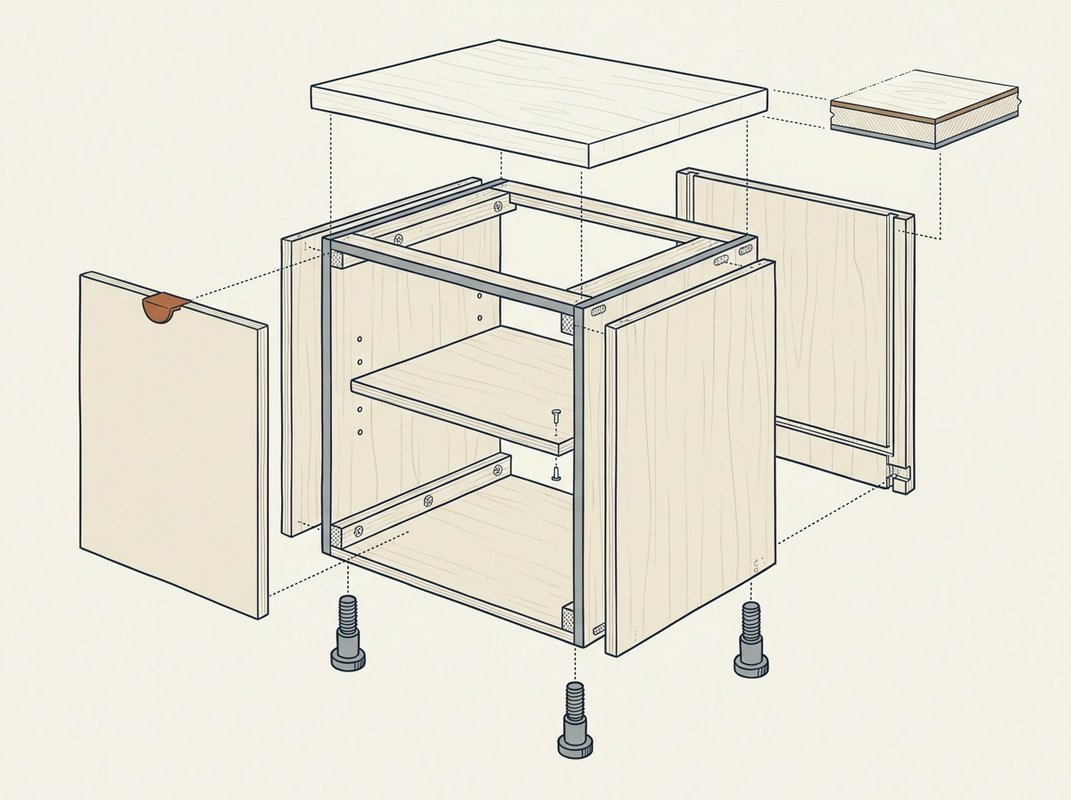
A cabinet's carcass is the structural box that everything else is fixed to: the two side panels, a base, a top rail (sometimes called a stretcher) running front to back, and a back panel closing the rear. Once the doors are hung and the worktop sits on top, none of it is visible, but it is what holds the shape of the cabinet and carries the weight of whatever goes inside.
The side panels and base do most of the work. They are cut from board, and the board has to be stiff enough not to bow once it is loaded with plates, pans or a worktop bearing down on it, and rigid enough to hold a hinge screw without the screw working loose over years of the door opening and closing.
Why the back panel is not an afterthought
Two different approaches are common. In one, a full board panel is fixed across the whole back of the carcass, usually screwed on. This squares the cabinet up on its own and gives you something solid to screw through into a wall bracket when the unit is hung. In the other, a thinner panel sits in a groove routed into the sides, which is lighter and uses less material but does little to stop the carcass racking out of square. Where that is how a cabinet is built, the cross rails and any internal fixings are doing more of the work of keeping it square, so it is worth knowing which construction is behind the doors you are looking at.
The gap left between the back panel and the wall is the service void, the space a plumber or electrician uses to run pipes and cables without cutting into the cabinet itself. How that back panel is built, and how much of it is solid rather than open, has a bearing on how easily that void can be used and on how well the cabinet stands up to the damp air around a sink run.
Board type, thickness and back panel construction vary between ranges, and the figures for a specific range are worth checking against the maker's own page. See the hinges, runners and soft-close guide for how the carcass connects to the moving parts, or compare guarantees to see how long a maker stands behind the carcass itself.
Chipboard, MDF or plywood: what the carcass is made from
The carcass is the structural box of a cabinet: the sides, top, bottom and back that the door hangs on and the shelves sit inside. Almost every fitted kitchen sold in the UK builds its carcass from one of three boards, and knowing which one you're looking at tells you a lot about how the cabinet will behave once it's loaded with pans and plates and living in a room that gets steamy and damp.
Chipboard, MDF or plywood
Chipboard is wood particles bonded under pressure and faced with a melamine layer (often called MFC, melamine-faced chipboard). It's the most common carcass material because it's stable, flat and inexpensive to produce in volume. MDF (medium-density fibreboard) is made from finer wood fibres, which gives it a smoother edge and face, so it's often used where an edge will be shaped or painted. Plywood is thin layers of real wood glued with the grain running in alternating directions, which makes it stiffer and more resistant to screws pulling out, at a higher cost than either of the other two.
Thickness
The board's thickness affects how much a shelf will sag under weight and how securely a hinge or drawer runner can be screwed into the side panel. A 16mm carcass side is the minimum you'll find in a mass-market flat-pack range. 18mm is thicker and stiffer, and it's standard in most rigid and trade ranges. A thicker board also gives a hinge or runner screw more material to bite into, which matters over years of doors and drawers opening and closing.
Edging
Wherever a cut edge of board is exposed, whether on the front of a shelf or the top of a side panel, it needs a strip of edging (usually PVC or ABS tape) glued and trimmed over it. Board without edging left exposed will absorb moisture at that raw edge and swell, so it's worth a look inside a display cabinet at the showroom to see whether every visible edge has been finished.
Moisture resistance
Standard chipboard swells and loses its strength if it stays wet. Many ranges offer a moisture-resistant version, sometimes described as "green" board because of a dye added during manufacture, for cabinets that sit under a sink or close to a dishwasher or washing machine. Where a base unit takes the sink bowl, moisture-resistant board is worth asking for specifically, because a standard board left damp under a leaking trap won't recover the way a moisture-resistant one is designed to.
The trade terms you'll meet across every range are set out in the kitchen glossary, with a short definition for each one.
Carcass board, thickness and guarantee compared by range
Cabinet specification varies more than showroom doors suggest. The board type, its thickness, the back panel and the guarantee attached to the carcass are all published by the maker, and it's worth reading them side by side before you commit to a range.
| Range | Board & thickness | Back panel & build | Cabinet guarantee |
|---|---|---|---|
| IKEA METODSuits buyers assembling the kitchen themselves or paying a fitter by the day; check the fitting quote assumes flat-pack labour. | 18mm particleboard frame with melamine foil | Fibreboard back panel; supplied flat-pack, 800mm cabinet height | 25-year guarantee |
| Magnet Ludlow, Ready to AssembleThe lower-cost build within the range. Ask whether the fitting price already covers assembly time. | 16mm board | Flat-pack carcass, built on site | 15-year guarantee |
| Magnet Ludlow, Pre-BuiltRigid units cost more to store and deliver, so lead times are worth asking about before ordering. | 18mm board | Rigid carcass, delivered pre-built | Lifetime cabinet guarantee (Magnet's site-wide promise) |
| HowdensSold through trade depots, so you will usually meet these figures through your fitter. | UK-made cabinets; board thickness not stated on the page checked | 72mm service void and 575mm depth on standard base units | 25-year cabinet guarantee; doors and Lamona appliances carry separate terms |
| DIY KitchensUnits arrive pre-built, so measuring the carcass against your appliance niches before ordering matters more than with flat-pack ranges. | Rigid construction, FIRA Gold certified | Example base unit (FD6 Highline): 720mm carcass height, 560mm depth, two hinges | Made in Britain; guarantee term not stated on the page checked |
Figures are taken from each maker's own product or policy page, read on 16 September 2026. Ranges change their specification and guarantee terms over time, so check the current page before you order, and see how guarantees are structured more broadly on the guarantees comparison.
The carcass height and board thickness you settle on feed straight into the finished worktop height.
Enter your carcass height, leg height and worktop thickness and the tool works out the finished height and whether your appliance niche is right, though it can only be as accurate as the numbers you put in.