What actually changes from one door style to the next
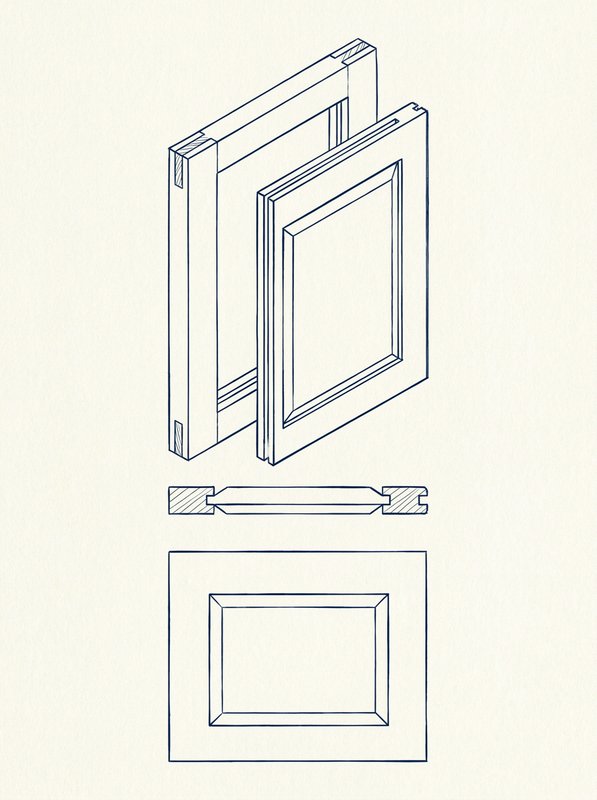
A door style is mostly a decision about the line running round the edge of the door and how it opens. Photographs of finished kitchens make styles hard to compare, because the room, the light and the cabinet run are never the same twice. Drawing each style against the same cabinet width, from the same angle, keeps the proportions honest: what changes is only the door.
- Shaker: a recessed centre panel framed by a flat rail, the reference point most other styles are described against.
- Slim shaker: the same recessed panel, but with a narrower rail, so more of the door reads as flat panel and less as frame.
- In-frame: the door sits within a face frame, so the frame stays visible around every door and drawer.
- Slab: a flat door with no frame or panel line at all. The gap between one door and the next is the only line there is.
- J-pull handleless: the top edge of the door is cut or profiled into a finger recess, so no handle is fitted to the door face.
- Rail handleless: a horizontal rail or channel runs along the top of a run of doors, gripped in place of a handle on each one.
- Fluted: vertical grooves cut or applied to the door face, usually over an otherwise flat or slab door.
- Glazed: a glass panel set into the door, most often within a shaker or in-frame profile.
Seen side by side like this, a shaker and a slim shaker are easy to tell apart on rail width alone, and a J-pull and a rail handleless door stop looking like the same idea with different names.
Door finishes: what each one asks of you day to day
The style you choose (shaker, slab, handleless and the rest) sets the shape of the door, but the finish sits on top of that and decides how it copes with steam, hob heat and everyday wiping down.
| Finish | Where you'll meet it | What it asks of you | If it gets damaged |
|---|---|---|---|
| Painted wood or painted MDF | Shaker, in-frame and painted slab doors | Wipe up spills at the sink and hob edges promptly, since paint can lift where water sits against a chipped corner. | A small chip can often be touched up with matching paint; a wider respray usually means the door goes away to a spray shop. |
| Foil-wrapped (vinyl) MDF | Budget shaker and slab ranges | Keep it away from sustained heat near the hob and oven, since the foil can lift where it's exposed to it for long periods. | Once an edge has lifted it isn't repaired, only replaced, so it's worth asking a supplier how doors are replaced under guarantee. |
| Laminate | Slab and handleless doors | Ordinary wiping down is all it needs; the surface doesn't ask for any particular product or routine. | A scratch or chip shows the board colour underneath and can't be touched up, so the door is replaced. |
| Lacquered or high-gloss acrylic | Gloss slab and handleless doors | Fingermarks and light scratches show up more readily than on a matt finish, so it tends to get wiped more often. | A scratch is usually buffed out by a specialist or the door is replaced; it isn't something to sand and touch up yourself. |
| Real wood veneer | In-frame kitchens and some shaker ranges | Keep it out of direct steam and standing water, since veneer can swell and lift at an edge if it's left damp. | Light marks can often be sanded back and refinished; a swollen edge usually means the door is replaced. |
This sets out what each finish generally asks of an owner; a maker's own care instructions for the door you're looking at take precedence over this.
What the door style decides for worktops, handles and lighting
Choosing a door style settles more than the door. It narrows the sensible choices for the worktop edge, the handle (or the absence of one) and how the kitchen is lit, though none of it is fixed until you've seen the combination on your own units.
Worktop edges
A shaker or in-frame door has a visible frame around a recessed panel, and a square or lightly eased worktop edge usually sits better against that line than a heavily rounded one. A slab or handleless door has no frame to answer to, so the worktop edge carries more of the kitchen's character on its own: a square edge keeps the whole run reading as one flat plane, while a postformed edge (where the laminate wraps over a curved profile rather than meeting a separate edging strip) softens it. Either way, the worktop height and any appliance niche it has to clear are worth checking against the carcass and leg height you've settled on, which the kitchen heights and sizes guide sets out.
Handles, or none at all
Shaker doors take most handle shapes comfortably because the frame gives a bar or cup handle somewhere solid to sit. In-frame doors are narrower across the face than the carcass they're fixed to, so a smaller cup or knob handle is often the better fit than a long bar. Handleless doors work two ways: a J-pull has the grip machined into the top edge of the door itself, while a rail handleless run has a slim aluminium rail set along the top of the cabinets that the whole row shares. Fluted and glazed doors are usually chosen to be looked at, so the handle tends to follow whichever of the styles above the rest of the kitchen is built on.
Lighting the run
A handleless kitchen removes the one visual cue that tells you where a door ends and a drawer begins, so plinth-level lighting (the panel at floor level that covers the cabinet legs) or a lit strip under the wall units usually does the work the handle would have done. In-frame doors sit slightly proud of the carcass, which can throw a shadow line along the top of a run if the cabinet lighting is fixed too close to the edge. Glazed doors bring a different question: whether the inside of the cabinet is lit, since that's usually the reason for choosing glass in the first place. None of this is decided by the door alone, and it's worth working through alongside how the carcass itself is put together, covered in how a kitchen cabinet is built.
A door style is only one half of the decision.
A handleless run sits differently to an in-frame door once worktop thickness and appliance niches come into it, and the figures you enter decide the answer, so it is worth checking them against the appliance's own instructions too.